Ah, winter, my favourite retrospective season, a perfect time to mourn the stillborn projects of past year and draw some candid conclusions for the next. Though I have a tendency in these pages to enthuse about the garden's most great and glorious crops, I should probably highlight that not everything conforms as willingly to my gardening dictates, or my taste buds for that matter. For balance, and in the spirit of horticultural transparency, here's three projects that turned out to be rather underwhelming in 2015:
1. Mashua
 |
| Mashua |
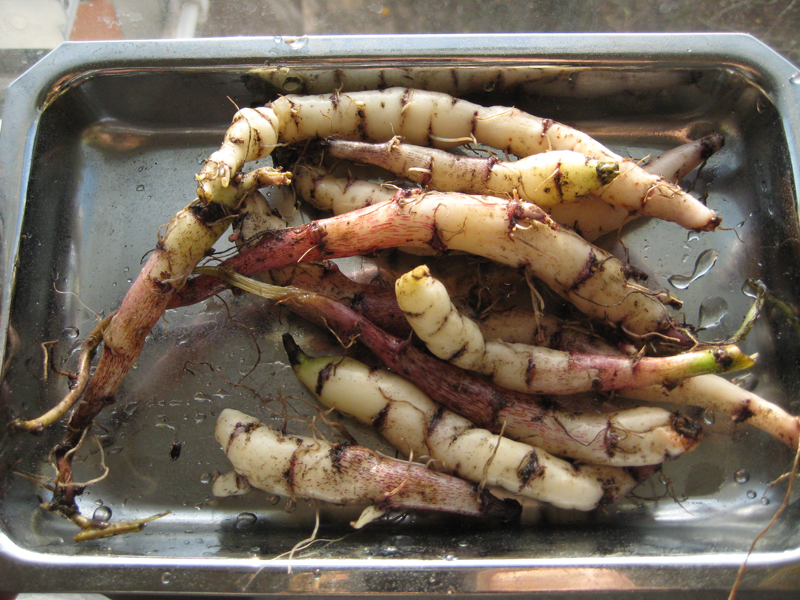
That's tropaeolum tuberosum, a family member of the garden nasturtium and part of my booming Andean root vegetable collection. It's quite ornamental, grows like a weed, is supposed to yield amazingly, and it has an enticing exotic background to boot. What's not to like? In fact, it didn't yield very well for me at all, which in all likelihood is because, much like my oca, the plants succumbed to the first frost at the end of October. Also like oca, it is daylight sensitive so I assume yields would have been significantly higher had I been able to keep the plants alive a few weeks more. A number of plants also mysteriously succumbed halfway through the growing season, probably due to some critter enthusiastically chewing through the root system.
 |
| Mashua tubers |
As it turns out, I'm not too sad that my mashua yields turned out as modest as they did, since my biggest beef with this plant is not with its gowth habit but with its taste. I had read quite a bit about mashua before I decided to plant some, and certainly the descriptions I found were mixed to say the least. From
"the tuber with the taste that torments" to descriptions that
compare its flavor to that of turnip, I wasn't quite sure what to expect. Since I actually quite like turnip, I figured it couldn't be all that bad. Having tried mashua a number of times now, and trying very hard to like it at least a little bit, I can however attest that the taste is something else entirely. It gives a very intense, spicy yet simultanously very perfume-y flavour that completely overwhelms your taste buds (or mine at least). In fact, after eating just half a small, cooked mashua the taste went straight to my stomach and I started feeling slightly uncomfortable. I'm quite sure I would have retched had I continued eating it. There are bound to be ways around this rather unpleasant experience.
William Whitson for example recommends submitting the roots to a long, slow cooking process with a good amount of fat and liquid in order to neutralize the taste. Sensible as that might be, it's just a bit more effort than I'm willing to spend on making something palatable. Call me a kitchen conservative, but with only 300 square meters of garden soil to my disposal and an endless list of projects waiting for their fair share, the least I expect of my plants is that they taste good. I'm sorry mashua, but I think I'm just not that into you.
2. Ulluco
 |
| Ulluco |
 |
| I suppose I could try it as a condiment... |
In contrast to mashua, I can't really fault ulluco for its taste, since I haven't actually gotten around to eating it. I
reported earlier on how I found ulluco to be really slow growing, but it seems I hadn't quite appreciated just what this meant for my intention of eating it at some point. When I pulled up the 8 or so ulluco plants I had, at about the same time as the oca, I was forced to comb through the soil carefully in order to locate my harvest. More cynical people than me would say that growing ulluco the way I did is a novel and rather elaborate way of growing peas, since peas is surely what the 'tubers' I found resembled most. One monster was about the size of a pingpong ball. They're certainly very beautiful though, and apart from their apparent attractiveness to slugs and their slothlike growth habit, they seemed quite happy in the climate here. Having consulted with some of the real ulluco experts out there, I now think I will need to pre-plant these babies indoors in spring if I want to get some actual tubers out of them. Oh yes, and then there's the whole daylight thing of course... Somehow all this doesn't quite fall in with my hands-off gardening philosophy. The choice that will haunt me the following months, therefore, is whether I want to pamper these tiny ulluco through another growing season in order to give them a proper trial, or if I should put this project on hold for a while. There's some interesting
developments in ulluco breeding taking place in gardens far more organised than mine, which I anticipate might ultimately yield varieties more amenable to my growing conditions. I suppose I could just sit back and wait for those to materialize. Since I'm not known for my patience however, I have this slight suspicion I will be taking the pampering approach...
 |
| The entire ulluco harvest |
3. Achocha
I don't believe I've actually mentioned achocha before, but this is another of the Andean crops I tried out in 2015. It is a member of the cucurbit family and a close relative of such fascinating plants like the
exploding cucumber (cyclanthera explodens). Achocha grows a spiny, hollow fruit with big black seeds that can be eaten either immature like a cucumber, or mature like a green pepper, whose tastes it is supposed to resemble in those stages. I obtained two varieties from
Real Seeds, 'Fat Baby' and 'Giant Bolivian Achocha' (a.k.a. caigua). The two seem to belong to distinct species, respectively cyclanthera brachystachya and cyclanthera pedata, and certainly the true leaves turned out to be rather different. Leaves of the Giant Bolivian somewhat resemble that of cannabis indica, which I imagine might provoke concerned looks from the neighbours. I sowed two plants of each indoors in late April and planted all of them out in May. Both germinated easily enough and grew quite vigourously. Unfortunately the slugs seemed to be extremely fond of the Giant Bolivian. The two plants never had a chance; they were decimated almost the moment they were planted and never recovered. The Fat Baby fared much better and grew well despite the cold and wet summer. It was slow to flower but once it started, sometime in August, it produced masses of tiny yellow flowers that yielded an abundance of small, green spiny fruits - the spines are soft so you can easily eat them like that. Unlike cucumbers, which can be quite challenging to grow outdoors here, Fat Baby just took off and never looked back, which is why some people have been promoting it as a good temperate-season cucumber alternative. Having said that, I find the taste decisively less interesting than cucumber. Achocha does taste faintly similar, but it lacks the former's refreshing juiciness. I would also have to be a bit skeptical of the claim that the mature fruit, when cooked, tastes like a green pepper. Again, it has a hint of that flavor, but it's much less pronounced and more bland. Quite frankly, I don't think it tastes like all that much at all. That's a definite improvement over mashua, but not exactly something that gets me wildly excited. I've since read that achocha is nicest when picked rather young (I've mostly been eating it when it was very mature), and I have 3 more Giant Bolivian seeds to try out as well, so I might just give them another go. Maybe I'll unexpectedly become an achocha lover yet, but at the moment I'm not terribly impressed.
In terms of next year's gardening shortlist, that's a definite no-no for mashua and a half-hearted maybe for ulluco and achocha. Now to start dreaming about next year's new projects!