Saturday, 16 July 2016

Peas on my mind

Well not just peas, really, but several representatives of the Fabacaea, that is, the legume family. This year I've embarked on a small legume trial that I've somewhat bombastically titled The Great Legume Project. My aim is mostly to try some new things and have some good fun in the process, but I'm also interested in discovering which legumes I could adopt as reliable food staples, that is, for drying and using throughout the winter. Ideally of course, I would just grow all of them, all the time, and indulge in the incredible diversity that the legume family has too offer. There's probably a risk that I would do exactly that if I had hectares of land at my disposal. In the real world, however, my growing space is limited (and seems to come under increasing pressure every year), and so is my patience for plants that demand a lot of pampering without giving much in return. Selection there will be! Anyway, this post is a brief overview of the different legumes that I'm growing this year, and how they're doing so far. I already have half-developed plans for trialling mung beans and cow peas next year, so this project is unlikely to end here...

Fava beans

Ah, good old fava beans. Hardly a newcomer in the garden, but I've only ever used them in their immature form. I know you can eat the dried seeds like any other bean, but I've never done so, so I don't know if they're very good. I'm about to find out. There's five varieties currently inhabiting the fava bean patch: Aquadulce, Solberga, Express, Green Longpod and Göteryd. The favas have suffered a bit from the abundant growth in the neighbouring pea patch however, which has overshadowed them more than I had reckoned with. If you think this implies a certain bias in favour of the peas on my part, you're probably right to some extent... To be very frank, I'm mostly interested in the immature favas, which I know are great. But I promise I'll try to contain myself and give the dried seeds a chance as well.

Peas

Whereas I'm yet to fully fall for the fava, I'm already a complete pea convert. I'll have peas in all their forms and shapes, please. The fresh peas I grow never make it to the kitchen though, I usually just munch on them in the garden, if the d*mned pigeons don't get to them first, that is. This year, however, I'm particularly focused on the dry/soup peas. I'm growing six varieties: Govorov, Klosterärt, Bjurholms småärt, Sollerön gråärt, Biskopens gråärt, and Gotländsk blåärt. The Govorov and Bjurholms småärt (Swedish for 'little pea from Bjurholm) are green peas, the Klosterärt is a yellow pea, and the other three are 'grey peas', aka black or maple peas. The maple peas are supposed to make a good substitute for chickpeas, so I'm really, really (really!) curious about them, I've never tried them. Sollerön and Biskopens have pink flowers, green pods and brown/red seeds, while the Gotländsk blåärt has purple flowers, purple pods and red/brown seeds. They're very ornamental, and all seem to be extremely prolific, particularly perhaps Klosterärt and Bjurhölms småärt. Sollerön and Biskopens were the last to flower, but all are coming along nicely now. I can't wait to dig my hands into a jar of homegrown dried peas! So yes, I suppose I should admit to a certain bias towards the peas, they've already earned their permanent residence in my garden. If only I could grow a lot more of them, somehow...
A wall of peas: Klosterärt and Bjurholms småärt
Chickpeas 

The peas are vying with the chickpeas for the title of most favoured legume crop. As anyone who has grown them will have to agree, there's just something incredibly loveable about chickpea plants, with their feathery leaves, their wavy growth habbits and their cute little flowers and seed pods. So yes, these are coming back next year as well, and in fact I've already ordered a couple of heirloom varieties from the US to seriously expand my chickpea trials next year. This year I'm growing three batches: Black Sicily, a black chickpea; Golden Dragon, an orange/yellowish variety; and a blend of standard tan chickpeas from various grocery stores. I sowed all of them at the end of March, together with the peas and the fava beans. The Black Sicily and Golden Dragon were quick to emerge, but cutworms got most of the seedlings. I therefore had to resow, after which more were cut down, and in the end I was left with only 15 plants or so in total. The grocery store mix never emerged, so then, a few weeks later, I decided to sow the entire jar, which must have been several hundreds of seeds. Only two plants finally came up. I suppose this is largely due to environmental conditions. The Black Sicily and Golden Dragon apparently were selected for emergence in cooler soils, which makes them valuable in my conditions, seeing that it's unlikely I would get mature chickpeas if I would wait until the soil has warmed before sowing. The plants seem to have enjoyed the warm spring. They are growing well and are bearing an abundance of pods. I suppose I'll need to save most of the seeds for next year's expansion, but perhaps a modest homegrown hummus is within the range of possibilities. Patience, patience. 

Lentils

Lentil 'Gotlandslins',
with potato onions in between
Last year I grew 'Gotlandslins', a lentil variety that derives from Gotland, Sweden's largest island. The rabbits got most of them however, and what was left resulted in a pretty meagre yield. I wasn't all that impressed but couldn't resist sowing them again this year. This time I've managed to keep the rodents out, and the plants generally seem to be doing much better than last year. There's plenty of pods on the plant, so I might actually be able to eat some of the lentils this year. Overall, these are quite fun to grow, and they're definitely cute, but as a potential staple crop I can't help but feel that they're a bit too much bother. If only the seeds would be five times as large, and grow together in long pods. A bit like a pea, say... Now there's a plant breeding challenge.


Dry bush beans

Dry beans are perhaps the centrepiece of any legume collection, if only because of the vast variety of different colours and patterns that are out there. I had to seriously restrain myself when ordering bean seed, and even then I still ended up with an dry bean patch twice the size of any of the other legumes. I'm growing a bush variety of Borlotti beans, some store-bought Swedish 'bruna bönor' ('Brown beans'), Stella (another brown bean), Hutteriternas Soppböna (a pale, greenish, and very plump round bean that I received through Sesam, the Swedish society for the preservation of heirloom vegetable varieties), Brightstone (a brown bean with dark blue speckles) and Wolverine's Orca (a black&white bean that indeed looks a bit like an orca whale). The plants are flowering at the moment.

Lupin

And finally, a bit of a outsider: lupin beans. The species that I'm growing (L. albus) is far from appropriate as a staple food (it's supposedly quite bitter and requires extensive preparation before it's palatable), but I nevertheless look forward to trying it as a novelty food. Lupin beans, soaked for extensive periods in order to leach out the alkaloids, are a popular snack in some Mediterranean countries. Supposedly there are a number of 'sweet' lupin varieties around that have been bred for lower alkaloid content and therefore require no soaking (particularly some strains of L. angustifolius), but these seem a bit hard to get a hold of. I've yet to get my hands on them at least, but they are definitely on the wishlist. The L. albus, meanwhile, has been treated somewhat unfairly the past few months; I all but neglected it during most of the spring and early summer. Despite the lack of watering and the dry spring it has done well and is now flowering quite happily.

That's about it for the (dry) legumes this year. So far so good.

Sunday, 29 May 2016

Sweet potatoes and some sweet sweet potato seed

Slips ready to be potted
Summer's here! Well, that's what it feels like at least. We've been having an unusually warm May here, with a monthly average some 3°C higher than usual and extended periods of hot and sunny weather. As a result, the garden has gone into turbo-mode and I've already managed to plant most of the sweet potatoes. Usually the beginning of June is a more reasonable time for this, though I never seem to have the patience to wait that long. Now though, some are already starting to put out new growth, so my impatience is actually paying off for once. I have a bunch of latecomers that are refusing to put out slips, but with tropical weather forecasted for the coming week, they'll catch up soon I hope. Barring some serious force majeur, that means I now have a final list of the varieties I'll be growing this year:
  1. T65 - reliable producer, does not flower.
  2. Georgia Jet - should be a reliable producer, but did badly for me last year. I obtained what I hope is a better strain, so let's see. Should flower easily.
  3. Purple - (I called this Nordic Purple before, but I'm pretty sure it's the same variety that is elsewhere known by the name Purple) - purple-fleshed variety, not very productive but flowers profusely.
  4. Bonita - only had one plant of this last year, so it's hard to say how productive it was, but it flowers.
  5. Burgundy - same as with Bonita, plus the tiny tuber I managed to overwinter is just starting to put out slips. Flowers.
  6. 'Nordic White' - unknown white-fleshed variety, fairly productive here, and flowers.
  7. 'Nordic Orange' - medium productive, but I'm not sure if it flowers. I thought I saw some flowers on it two years ago. If it doesn't flower this year, I'll drop it.
  8. Mystery - a Georgia Jet mutant, haven't grown this before, but if it's anything like Georgia Jet it should flower easily.
  9. ? - a complete mystery this one! 
  10. Bunduguza - starchy white-fleshed African variety, lowish yield, no flowers.
  11. Burundi - starchy yellow-fleshed African variety, lowish yield, no flowers. This was the best out of all the African varieties I tested last year.
Then there's two varieties from the highlands of Papua New Guinea, a region that apparently can get quite chilly at night (relatively speaking of course, it's still a tropical area), and so should theoretically be somewhat cold-adapted. There's some hope, therefore, that compared to your average I. batatas variety, these two will feel a bit more at home here in maritime Malmö. They will join the others in the garden, provided they put out some slips soon. Both have roots, and one has a tiny slip forming, but I sure wished they'd hurry up a bit:
  1. Kainantu 
  2. Aiyura
I. batatas seed sprouting
And then, just as I thought I would get away with growing just 11+2? varieties this year, I received a small package with seeds. That is, proper sweet potato seeds, that rarest of things! These too are from the Papua New Guinean highlands. In practice, I suppose the chances are fairly slim that anything useful will come out of them. I generally put more faith in efforts to produce seeds under northern growing conditions, as Telsing Andrews has succesfully done last year, and as I hope to achieve myself this year. Nevertheless, a tiny chance is still a chance worth pursuing, plus it will be loads of fun to play around with these seeds. I promptly scarified some of the seeds with sandpaper, soaked them for half a day, and sprouted them. Germination rate was higher than I had anticipated, of the 35 seeds I soaked, 29 sprouted. That's 29 new sweet potato varieties, right there. Quite a bit of difference showed up in the phenotypes, with some seedlings showing intense red leaf colouring, some being completely green, and some lying somewhere inbetween. True leafs are deltoid or cordate, with a few of the seedlings having toothed edges.
About half of the seedlings
The batata battle plan for 2016 then: 1) Grow everything under a floating row cover for as long as practically possible, in order to speed up flowering. I've given this some thought and I didn't want to go the plastic mulching route just yet, I'd prefer to get seeds without too much 'cheating' technologies. Call me a botanical luddite! 2) Evaluate varieties for flowering onset, potential seed-set, and yield. 3) Share flowering varieties with collaborators in order to increase the chances of seedset under nordish conditions. 4) Acquire more flowering varieties. 5) Repeat.

 As simple as that!


Saturday, 14 May 2016

Bloom for me, mirabilis expansa

Mauka seedling, Spring 2015
I realize that a status report on last year's mauka cultivation is long overdue. I was holding off this post hoping that I would be able to invoke your envy with some pictures of my magnificently flowering mauka, but alas, the Inca gods refused to bestow this pleasure upon me. It might very well be that I angered them somehow. As you will remember, mauka combines the unfortunate characteristics of being frost-tender and flowering under short-daylength conditions, right in the middle of the European winter. I therefore brought in two mauka plants (one Roja [that I had mistakenly labelled CIP208001 before] and one Blanco) in November with the intention to induce flowering and produce seeds. Let me clarify that I don't possess the best of conditions for overwintering plants indoors. I live in an appartment that gets quite dry in winter and the only outdoor space I possess is a 2sqm balcony (that I manage to cram full of plant starts in spring). Greenhouses, spare rooms, cold banks and root cellars are utopian concepts to me. If anyone would like to make me a present of, say, a farm, that would be very much appreciated...

Mauka root close-up, with wireworm damage
Anyhow, the maukas got a rough ride through the winter. Shortly after I brought them in, both plants got infested by aphids, which in a warm, dry and predator-free environment is prone to spiral out of control pretty quickly. Since we don't usually get frosts that often here in November and December, I figured I could more or less control the aphids by keeping the plants out on the balcony as long as possible, and just transporting them inside whenever a frost threatened. This worked pretty well for a while, but then one day in December (I guess you see where this is going..) we had a rather violent storm that pretty much blew the foliage to pieces, leaving behind a sorry-looking, bony mauka skeleton. The plants were undeterred however and quickly sprouted new leaves indoors. Then I was travelling over Christmas and New Year's, and upon my return I discovered that my absentee watering regime had failed me. Again, both mauka's lost their entire foliage, but they weren't dead and again resprouted leaves, although much less decisively than the first time. A plant that takes this much abuse definitely has my respect, though I would rather have avoided it.

But then there they sat, during January, February, and March, with no signs at all of flower buds appearing. Frustrating. I dutifully ferried them between the balcony and the living room, gave them all the love and attention I had to give (well kind of, anyway... the Roja plant eventually died somewhere towards spring, I'm not sure why...) but apparently it just wasn't enough for Pachamama and colleagues. The mauka flowering code remains uncracked, for me at least. I've now planted the Blanco in the garden together with its siblings. I might give it another shot next year, or else I'll try to lure a helpful greenhouse owner into adopting a mauka plant or two for the winter. Any volunteers?

Mauka Blanco
Mauka Roja, 2nd year growth
Seeds are not everything of course (though I have to confess I think increasingly more of them). What my plants did produce last year was plenty of roots! Of the nine Blanco seedlings that I harvested (I left a couple in the garden to see if I could overwinter the roots in situ - the answer is no), all but one were significantly larger than the first-year roots I had harvested from my two Roja plants the year before (both of which were a meagre 150 grams). Root weight ranged from 120g to 700g, with 3 roots weighing 500g or more. I also had three Roja plants (two plants in their second year, and one cutting) that were 1kg, 1,1kg, and 30g. All in all a pretty good result, which somehow confirms my hunch that the Blanco variety is superior to the Roja in terms of yield. Observation also leads me to believe that the Roja is marginally more susceptible to (light) frosts than Blanco, though the difference is probably a matter of decimals. They will definitely need more than that if they are to stand their own against the Swedish winter.

There's plenty of roads still to be travelled for mauka and me in 2016 and beyond. Apart from seducing it to bloom sooner or later, I would also like to get my hands on the CIP208001 variety, which looks a lot like the Roja but should have much better yields. And then of course, it would be exciting to try and find some additional varieties. After all, who knows what unexplored gems are still hiding somewhere in mauka's Andean homelands...

Wednesday, 16 March 2016

Early spring musings - 2016

Time for the early spring musings - 2016 edition, also known as my Utopian elaborations on the coming season's gardening projects. As last year, early spring can here be interpreted rather euphemistically, seeing that the weather for the moment is still decisively wintery. But it's March, and March equals hope times plenty of ambition in my book. Without further ado, and in no particular order of appearance, here's a few of the projects that I intend to pursue in and around the garden this year:

 C. maxima landrace

Sweet Mama seed
Last year, I confessed to a 'slight' obsession with growing winter squash and elaborated on my intention of creating my own c. maxima landrace variety. I've eaten my way through most of the maxima stash by now and there's a definite pattern to be discerned. Sweet Mama is by far the most reliable and consistently delicious variety. Sweet Meat OH and Marina di Chioggia were a disappointment last year, which was surprising since Sweet Meat OH gets lavish comments all over the internet and Marina di Chioggia was one of my absolute favourite squashes the year before. The weather can probably be blamed here, since Sweet Mama is a short-season squash while the other two require a long growing season, which the chilly summer of 2015 failed to provide. As a result, those heavenly squashes that I ended up saving seed from were for the most part Sweet Mama's, with a couple of decent Green Hokkaido's and Burgess Buttercups making up the balance. Since this is the whole point of a landrace project, I'm proceeding as planned and will be growing out the F1's this year. In parallel though, I'll be making some controlled crosses as well, mostly to try and dehybridize Sweet Mama and to cross Sweet Mama with Marina di Chioggia, the idea here being that I wouldn't mind a shorter-season version of the latter. I also couldn't really restrain myself and I've bought a few (or, well, quite a lot...) new varieties to try out: Blue Kuri, Sibley, Blue Guatemala Banana, Bon Bon, Crown Prince, Buen Gusto de Horno, Blue de Hongarie.... Hmmm. I guess I'll never run out of new winter squash varieties to try...


The C. moschata project will be put on hold for the time being. I grew three moschata's last year: Longue de Nice, Long Island Cheese, and Waltham Butternut and I quite disliked the taste and texture of the first two varieties, though I'm not entirely sure they managed to mature fully. The butternuts were certainly not fully ripe when I picked them in early October, but after a few months on my attic they turned out to be a lot more tasty than I had expected. I think it would be worth pursuing a moschata breeding project here, but I simply don't have the space to do it this year. Something for the future...


Sweet potato

Nothing like starting sweet potato slips to indicate
the (imminent) arrival of spring!
Of the 37 sweet potato varieties that I trialed in 2015, most didn't produce anything worth keeping. A few did, however, so the sweet potato adventure continues into 2016. I'll attempt to be a bit more serious about producing seed this year, while also continuing to scour the planet in search of those more cold-tolerant varieties that simply have to be out there somewhere (Papua New Guinea, are you reading this?). The sweet potato gods were kind enough to provide me with some Georgia Jet (amongst others), so it will be exciting to see if it finally lives up to its reputation in my garden. I recently inspected the tubers that I had saved, and most of the larger ones made it through the winter fairly unscathed, despite extensive cutworm damage. Some of them already had tiny sprouts forming, so I've put them in water now, where they will sit happily for a few months and hopefully produce a good amount of slips by May or so. At the moment I'm counting on growing 10 different varieties this year, though knowing myself this number is likely to increase somewhat... More on this as sweet potato planting time is drawing near!


Skirret


Skirret. The roots get much more impressive
than depicted here though (img source)
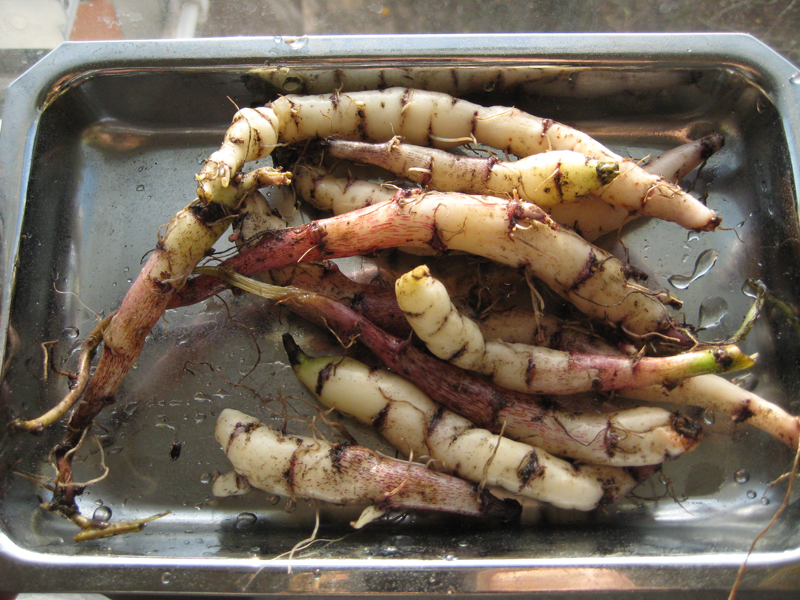
Last year marked my first attempt at growing skirret (Sium sisarum), a perennial root vegetable in the Apiaceae family and one of the 'Lost Crops of the Europeans'. Introduced in Europe by the Romans from its Chinese homeland, skirret appears to have been quite popular in these regions until the 18th century or so, after which the potato's march across the continent pushed it into botanical oblivion. Having grown and tasted it, I would say it's high time for a skirret renaissance. The plants are hardy and form clusters of fairly thin white roots just below the surface, which can become quite large over the years (the root clusters that is, not the individual root 'fingers'). These can be left in the ground over the winter and harvested whenever the skirret cravings hit you. Essentially, you just dig up the plant when you need it, break off the most seductively looking roots, and replant the rest. Easy like skirret pie! The Dutch (suikerwortel) and Swedish (sockerrot) naming of the plant attests to its taste, which is sweet and very pleasant. In fact, skirret has soared rapidly in my vegetable hall of fame and became one of my absolute favourite vegetables last year, and I'm sure I haven't even begun to explore the full extent of its culinary delights. Peeling the pencil-sized roots can be a bit of a pain, but it's actually completely unnecessary since the peel does not interfere with the taste at all. Just scrub, cut and cook! Some reports mention that the roots can have woody cores, but I have not noticed this in any of the skirret I tasted last year.

There are some budding attempts underway to breed skirret varieties with fewer but thicker roots, which I'm hoping to make a modest contribution to. I've been getting seed from different places and also saved some of my own (skirret flowers every year and readily produces seed), so I will be growing out a lot of that and then start doing some selection. Of last year's plants I kept the ones that looked most promising, so it will be interesting to see how they do in their second year.


Oca

Another first for me last year was growing oca, a favourite amongst Andean tuber enthusiasts. Despite a fairly early frost I was quite happy with the result and I hope I can reproduce or improve upon the yield in 2016. I've been eating quite a lot of different oca's this winter and I must say they now rank quite highly in the aforementioned hall of fame. They're particularly good when baked in the oven. At some point it might be worth doing a more organized taste test to identify the tastiest and most starchy varieties, which definitely would be a criteria worth considering in any future breeding attempts. Anyway, I thought I already had quite a few different varieties last year, but then I went to visit Frank van Keirsbilck some time ago and I somehow - entirely inadvertedly, honestly! - came away with an additional 10 varieties. Together with the GOB trial that I will be participating in this year as well, and the grow-out of my own oca seeds, 2016 is promising to be a pretty oca-esque year. No complaints there!


The Great Legume Project


Some cute beans I'll be growing
Beans beans beans... With all the roots, tubers and winter squash that I am growing, I'm not usually at risk of suffering from carbohydrate shortage. I could definitely grow a bit more protein crops though, so for a while now I've been playing with the idea of upscaling my legume cultivation. Enter the 2016 Great Legume Project. This year's garden will have a large section dedicated to testing different legumes for dry seed consumption. Last year I already grew a Swedish lentil variety called 'Gotlandslins', but it mostly ended up feeding the local rabbit population and in the end I barely got more seed out of it than I had planted in the first place. Not entirely successful, in other words. I'll give this lentil variety another go this year, and I'm adding a bunch of different chickpea varieties (mostly from store-bought chickpeas, but also a black and orange variety from Adaptive Seeds in the US), different fava beans, dry bush beans, and a couple of Swedish heirloom 'gråärter' (grey peas), which apparently are called black peas or maple peas over yonder in Britain. I'm particularly excited about the chickpeas and the maple peas. The latter apparently were a northern European staple in the days of yore and are currently being promoted by some enthusiastic agriculturalists here as Sweden's answer to the chickpea. I'm quite fond of dried peas and they tend to feel comfy in somewhat colder climates, so I'm anticipating a bit of magic to happen between me and the peas this year. Chickpeas apparently are more cold-tolerant than I had thought (at least based on Carol Deppe's account in Breed Your Own Vegetable Varieties) so perhaps the prospect of a homegrown hummus is not as far-off as I had feared. As to the dry beans, the plan is to grow a classical Swedish brown bean, a couple of other heirlooms, and a few colourful short-season US varieties. More on this trial as it happens!


The Modest Melon Project

Last autumn I received a small treasure in the mail, containing the seeds from a cross between 6 early watermelon varieties and the offspring of one early muskmelon (Blenheim orange). As far as melons go, I've only ever grown a 'babymelon' variety before, on plastic mulch, and though they did quite well the taste wasn't all that exciting so I never really bothered continuing with it. The arrival of these early, and actually good-tasting varieties is about to change all that. Since I don't have access to a greenhouse on my allotment, growing melons is definitely a challenge which means that my aims with this year's melon project are very modest. I'll be growing a few plants of each variety/cross and hopefully get at least a melon or two out of it. In fact I'll probably be ecstatic if I manage to haul as much as one ripe melon to safety before someone ends up stealing it. Then I'll save seed and repeat ad infinitum. I suppose you know where this is going..


Residual trials

And then, of course, there's everything else. Before this post turns into a monster, let me just finish by mentioning some of the new arrivals that I'm fairly enthusiastic about. Detailed descriptions to follow later!

- Hopniss (Apios americana): Also known as the American groundnut, Indian potato, or potato bean, however you like to call it. This a tuber-forming legume that was highly valued by native Americans, who knew a thing or two about valuable food crops. It's a perennial that apparently takes a few years to really give a worthwhile yield, so I'm not exactly expecting bumper harvests. Nevertheless, as you might have figured by now I find the prospect of growing new root crops pretty impossible to resist.

- Yacon (Smallanthus sonchifolius): New root crop no. 2, this is another Andean native, relative of the sunflower and the Jerusalem artichoke. It's high-yielding and supposedly fairly easy to grow. Produces large, inulin-rich tubers that are crunchy and sweet and can be eaten like a fruit.

- Quamash (Camassia quamash): New root crop no.3, a perennial, native of North America, also highly valued by the continent's pre-Columbian inhabitants. Quamash needs a couple of years to bulk up as well, so expect plenty of pictures of microscopic tubers.

- Crosne (Stachys affinis): Alright, I admit it, I'm mostly growing root crops, or at least those seem to the plants that made it onto this not very random shortlist. Perhaps I should work on countering that bias... I do like my greens, really. Anyway, crosne or Chinese artichoke is a perennial of the Lamiaceae, or mint family. It forms masses of small, worm-like tubers that are supposed to be delicious but a bit of a pain to clean. Worm-like tubers, anyone?

- Potato (S. tuberosum Group Phureja): I fear I might be becoming a potato snob. I recently caught myself ranting about the qualities of Arran Victory, which was one of last year's potato revelations for me and as I recently discovered is described by William Woys Weaver (in 100 Vegetables and Where They Came From) as the ultimate potato. Is this treading the potato equivalent of microbrew hipsterdom and coffee snobbism? Please stop me if at my next restaurant visit you find me complaining about the inferior potato variety that I was served. In any case, no, this won't be my first year growing potatoes, but it will be my first to grow Inca Bella, which is a potato variety of a completely different subgroup from the S. tuberosum group that the vast majority of European potato varieties derive from. It's supposed to be really, really delicious, so take note fellow potato heads.

- Turnip-rooted chervil (Chaerophyllum bulbosum): I don't know what it is with me and this plant, but I've yet to succeed in getting it to sprout for me at all. This will be the third year that I'm trying to grow it. I sowed the seeds in autumn and they have been outside the whole winter (they need stratification), so if I don't get anything now I'm _so_ blaming the seed company (again). Root chervil is supposed to be very delicate in taste, and sounds well worth the painstaking effort required in growing it (painstaking for me, at least). Just checked the pot, nothing sprouting yet...

A baby pig nut... hopefully!
- Pig nut (Bunium bulbocastanum): In Dutch this is called aardkastanje, and in Swedish jordkastanj, both of which literally translate as 'earth chestnut', since the taste of the tuber supposedly resembles that of sweet chestnuts. This is another perennial in the Apiaceae family, and another plant that would probably benefit from some selection (or more correctly, we would benefit from that..) since yields are purportedly very small. Pig nut is a pretty rare plant (at least in Belgium and the Netherlands) so I'm not entirely sure that the seed I have is actually B. bulbocastanum. Time will tell, at least I've got something sprouting in the pot I sowed with this.

Right, that's not all of it, but a big part at least. I know, I know: next time, more greens!

Saturday, 27 February 2016

On growing quinoa, and the long road to actually eating it

I think somebody should do a study on the political ecology of quinoa production. About a year ago, prices for (organic) quinoa in supermarkets here suddenly doubled, from about SEK 80 to an exorbitant SEK 150 (about EUR 17) per kg, and they haven't really come down since. Undoubtedly this is partly a reflection of the tiny grain's transition from obscure superfood to mainstream hipsterdom. I could imagine that farmers in Peru and Bolivia, where 95% of quinoa is grown, are struggling to keep up with the soaring demand created by the quinoa-devouring populations of Berlin, Stockholm and New York. Undoubtedly also, this has set in motion a host of transformations for traditional quinoa growers that have left them more exposed to the wits of global commodity markets and the health-food fads of prosperous Westerners (yes, I am including myself here). Certainly, there's boundless other factors waiting to be explored as well. A timely and interesting subject, if I say so myself. Any takers? I'll throw out a potential research question: How will Andean producers be affected once global quinoa prices drop, as they are likely to do when production in the US, Europe and elsewhere picks up?

I wished that my motivation for growing quinoa during the past year was entirely given in by lofty moral considerations such as these, some kind of Marcusian Great Refusal on my side, an attempt to one-up the global quinoa market by actively disengaging from it. More mundanely though, I just kind of liked the idea of trying to grow my own quinoa. Surely nothing that I could buy in the supermarket could taste as great as what I had grown with my own hands? I had read somewhere that apart from maize, quinoa is probably the only grain worth growing on a backyard scale, since per-plant yields can be quite respectable. As I'm not the greatest quinoa consumer (I confess to a weakness for Fagopyrum esculentum [buckwheat] instead), I figured a few plants would go a long way and decided to give it a go. So on the 10th of May last year, I filled three rows with the tiny seed, perhaps 15m in total, and waited for them to come up. I now think I could probably have sowed quite a bit earlier as well, quinoa seems to germinate at fairly low temperatures. I sowed three out of the four different varieties that I had acquired from Real Seeds in the UK, and Nichols Garden Nursery in the US, and one of them ('temuco') didn't come up at all.


The fun thing about growing quinoa is that, as the plants emerge, you will have no idea if you're actually growing quinoa (Chenopodium quinoa) or just lambsquarters (Chenopodium album), the common garden weed that is a close relative and that looks identical in the early stages of growth. In my case, a lot of the quinoa didn't come up, but quite a bit of quinoa look-a-likes sprouted in between the rows. I don't have that much weeds in this part of my allotment, but I imagine things could become quite messy in places where there's a lot of lambsquarter seeds in the soil. Bemused, I just let all of it grow for a few months. Quinoa gets quite a bit taller than lambsquarters and is less bushy in its growth habit, so after a while it becomes easier to distinguish the two. Apart from that, this is a crop that really grows as easily as its weedy relative. I gave it a bit of compost and seaweed extract and then basically ignored it until autumn. There weren't really any real pest or disease problems to speak of, and I didn't have to water the plants at all (though we did have an unusually wet summer).


One of the Real Seeds varieties is called 'Rainbow' and gives you a spectular display of colours in autumn as the plants and the seed heads start drying. They're highly ornamental, ranging from green over brown and yellow to different shades of red, orange and pink. I finally cut off all the seedheads - perhaps 20-30 in total - during a dry spell in the beginning of October and hung them indoors to dry down further. This is basically where things become a little bit complicated. In order to get from a bushel of dried quinoa seed stalks to a neat pile of edible quinoa seed, you will need to thresh, sift, and clean the seed. This is not necessarily difficult but without the advantages of appropriate equipment or previous quinoa-threshing experience, it's a very time-consuming process. Together with a friend I ended up threshing each seed head by hand, then sifting the debris through canvases of different mesh sizes, and then winnowing what was left in small batches to get rid of dust and the smallest debris. Without wanting to claim that the results yielded by my primitive methods are generalizable in any way, it took several evenings to get a grand total of 1200g of quinoa. Let's just say I gained a lot of respect for the machineless quinoa-, sorghum-, amaranth-, millet-, etc- producers of the world. 

My authentic African winnow, finished with cow dung!
Swedish quinoa
Next, you need to carefully wash the quinoa in order to get rid of the bitter-tasting saponins that coat the seeds. Again, there's probably more sophisticated, energy-efficient and altogether smarter ways of going about this, but I just washed the seed a few times and then boiled it in plenty of water. It was still quite bitter at this point so I had to change the cooking water four or five times before the bitterness had more or less disappeared. Apparently there's some saponin-free varieties out there, so anyone seriously thinking about taking up quinoa-growing could probably save herself quite a bit of effort by tracking down these varieties.

Now to get my head around the apparent resurgent interest for sorghum and teff. Actually, for anyone falling in love with sorghum, I understand it should be quite possible to grow in more northern climates...  I myself, though, have decided to abandon my (pseudo)grain-growing ambitions for the time being. While the result, in the end, was a quite delicious and very satisfying quinoa, I'm not convinced it's really worth all the effort. If I could grow quinoa on a slightly larger scale, I could probably be persuaded to invent/invest in some proper quinoa-adapted treshing equipment. Within the limits of my dangerously overcrowded suburban allotment however, it feels slightly more sensible to focus my botanical pursuits on less labour-intensive crops. More skirret, anyone?

Friday, 1 January 2016

Inconspicious failures and lesser successes

Ah, winter, my favourite retrospective season, a perfect time to mourn the stillborn projects of past year and draw some candid conclusions for the next. Though I have a tendency in these pages to enthuse about the garden's most great and glorious crops, I should probably highlight that not everything conforms as willingly to my gardening dictates, or my taste buds for that matter. For balance, and in the spirit of horticultural transparency, here's three projects that turned out to be rather underwhelming in 2015:


1. Mashua

Mashua

That's tropaeolum tuberosum, a family member of the garden nasturtium and part of my booming Andean root vegetable collection. It's quite ornamental, grows like a weed, is supposed to yield amazingly, and it has an enticing exotic background to boot. What's not to like? In fact, it didn't yield very well for me at all, which in all likelihood is because, much like my oca, the plants succumbed to the first frost at the end of October. Also like oca, it is daylight sensitive so I assume yields would have been significantly higher had I been able to keep the plants alive a few weeks more. A number of plants also mysteriously succumbed halfway through the growing season, probably due to some critter enthusiastically chewing through the root system.

Mashua tubers
As it turns out, I'm not too sad that my mashua yields turned out as modest as they did, since my biggest beef with this plant is not with its gowth habit but with its taste. I had read quite a bit about mashua before I decided to plant some, and certainly the descriptions I found were mixed to say the least. From "the tuber with the taste that torments" to descriptions that compare its flavor to that of turnip, I wasn't quite sure what to expect. Since I actually quite like turnip, I figured it couldn't be all that bad. Having tried mashua a number of times now, and trying very hard to like it at least a little bit, I can however attest that the taste is something else entirely. It gives a very intense, spicy yet simultanously very perfume-y flavour that completely overwhelms your taste buds (or mine at least). In fact, after eating just half a small, cooked mashua the taste went straight to my stomach and I started feeling slightly uncomfortable. I'm quite sure I would have retched had I continued eating it. There are bound to be ways around this rather unpleasant experience. William Whitson for example recommends submitting the roots to a long, slow cooking process with a good amount of fat and liquid in order to neutralize the taste. Sensible as that might be, it's just a bit more effort than I'm willing to spend on making something palatable. Call me a kitchen conservative, but with only 300 square meters of garden soil to my disposal and an endless list of projects waiting for their fair share, the least I expect of my plants is that they taste good. I'm sorry mashua, but I think I'm just not that into you.


2. Ulluco

Ulluco
I suppose I could try it as a condiment...
In contrast to mashua, I can't really fault ulluco for its taste, since I haven't actually gotten around to eating it. I reported earlier on how I found ulluco to be really slow growing, but it seems I hadn't quite appreciated just what this meant for my intention of eating it at some point. When I pulled up the 8 or so ulluco plants I had, at about the same time as the oca, I was forced to comb through the soil carefully in order to locate my harvest. More cynical people than me would say that growing ulluco the way I did is a novel and rather elaborate way of growing peas, since peas is surely what the 'tubers' I found resembled most. One monster was about the size of a pingpong ball. They're certainly very beautiful though, and apart from their apparent attractiveness to slugs and their slothlike growth habit, they seemed quite happy in the climate here. Having consulted with some of the real ulluco experts out there, I now think I will need to pre-plant these babies indoors in spring if I want to get some actual tubers out of them. Oh yes, and then there's the whole daylight thing of course... Somehow all this doesn't quite fall in with my hands-off gardening philosophy. The choice that will haunt me the following months, therefore, is whether I want to pamper these tiny ulluco through another growing season in order to give them a proper trial, or if I should put this project on hold for a while. There's some interesting developments in ulluco breeding taking place in gardens far more organised than mine, which I anticipate might ultimately yield varieties more amenable to my growing conditions. I suppose I could just sit back and wait for those to materialize. Since I'm not known for my patience however, I have this slight suspicion I will be taking the pampering approach...

The entire ulluco harvest


3. Achocha

I don't believe I've actually mentioned achocha before, but this is another of the Andean crops I tried out in 2015. It is a member of the cucurbit family and a close relative of such fascinating plants like the exploding cucumber (cyclanthera explodens). Achocha grows a spiny, hollow fruit with big black seeds that can be eaten either immature like a cucumber, or mature like a green pepper, whose tastes it is supposed to resemble in those stages. I obtained two varieties from Real Seeds, 'Fat Baby' and 'Giant Bolivian Achocha' (a.k.a. caigua). The two seem to belong to distinct species, respectively cyclanthera brachystachya and cyclanthera pedata, and certainly the true leaves turned out to be rather different. Leaves of the Giant Bolivian somewhat resemble that of cannabis indica, which I imagine might provoke concerned looks from the neighbours. I sowed two plants of each indoors in late April and planted all of them out in May. Both germinated easily enough and grew quite vigourously. Unfortunately the slugs seemed to be extremely fond of the Giant Bolivian. The two plants never had a chance; they were decimated almost the moment they were planted and never recovered. The Fat Baby fared much better and grew well despite the cold and wet summer. It was slow to flower but once it started, sometime in August, it produced masses of tiny yellow flowers that yielded an abundance of small, green spiny fruits - the spines are soft so you can easily eat them like that. Unlike cucumbers, which can be quite challenging to grow outdoors here, Fat Baby just took off and never looked back, which is why some people have been promoting it as a good temperate-season cucumber alternative. Having said that, I find the taste decisively less interesting than cucumber. Achocha does taste faintly similar, but it lacks the former's refreshing juiciness. I would also have to be a bit skeptical of the claim that the mature fruit, when cooked, tastes like a green pepper. Again, it has a hint of that flavor, but it's much less pronounced and more bland. Quite frankly, I don't think it tastes like all that much at all. That's a definite improvement over mashua, but not exactly something that gets me wildly excited. I've since read that achocha is nicest when picked rather young (I've mostly been eating it when it was very mature), and I have 3 more Giant Bolivian seeds to try out as well, so I might just give them another go. Maybe I'll unexpectedly become an achocha lover yet, but at the moment I'm not terribly impressed.

In terms of next year's gardening shortlist, that's a definite no-no for mashua and a half-hearted maybe for ulluco and achocha. Now to start dreaming about next year's new projects!

Sunday, 22 November 2015

Oh! You pretty things

Winter has arrived also for the Andean crops in my garden, so it's high time for some updates. 2015 was my first year growing oca (oxalis tuberosa), a major root crop in many Andean countries and probably one of the better-known unusual tubers from that region. In total I planted 14 known varieties and 7 varieties that I tested for the Guild of Oca Breeders (GOB). Due to a bit of self-induced force majeure however, the former got thoroughly mixed up, so from now on they're all going through life completely anonymous (at least in my garden). I'm not one to judge a tuber by its name, and at a very practical level it really doesn't matter.


The oca patch in the middle of October
Ideally, the oca growing manual clarifies, one keeps her/his plants alive until the beginning of December if one is to benefit from a fully matured crop. This is because oca plants get slightly confused in the long-daylight hours outside of their native Andean range and respond by refusing to produce tubers until after the autumn equinox. Here on the west coast of Skåne, which you could think of as the California of Sweden, we usually have the first frost sometime in November, or even, as in 2014, the beginning of December, which is pretty good in oca-growing terms. Not so this year though, when a forecasted 4°C one night at the end of October turned into an ominous -0.6°C and caught me completely off guard, therefore pretty much decimating the oca patch. Highly unfortunate considering the 3 weeks of mild and frost-free autumn weather that followed... The GOB plants got completely killed, while the other plants got frosted about 3/4 of the way, probably because they were spaced closer together and had much more foliage. Again according to prevailing oca-growing dictates, one is supposed to leave the tubers in the ground for some two weeks after the plants are killed by frost, since the tubers continue to bulk up quite a bit during this time. Which I duly did, albeit impatiently so.


White variety, 540g
I can testify that, because of its colorful nature, oca is a highly satisfying crop to harvest. I would say it's a bit like gathering easter eggs. Except of course that oca is so much more exciting than easter eggs! I mean, aren't they incredibly pretty? So euhm... yes, I dug everything up, bagged all the tubers per plant, washed them, weighed them, and then selected the ones I want to continue with next year. Considering the earlier-than-ideal harvest, I was pretty happy with the results (but then again, I have never grown these before so I have nothing to compare to and probably would have been happy with nearly anything). Most plants produced somewhere around 200-300g of small to medium-sized tubers, with the best one being a completely white variety that yielded 540g. According to the information over at Cultivariable, oca can yield up to 1kg per plant. Clearly, I'm pretty far away from that, but it's a pretty decent start nonetheless. I'm saving all but the poorest performing varieties for next year, since I want to ensure that I continue to have the diversity required to produce seed. Oca is namely a bit picky when it comes to pollinating partners.

Oh! You pretty things! These are the discards,
the tubers from plants that yielded less than 200g

GOB14178 - This from two plants
Seed!
Speaking of seed, quite a few of my oca flowered, and some produced seed in late summer and early autumn. With some 25 seeds in total, this can hardly be called a gigantic harvest, but it's enough to do a little bit of excited experimenting next year. For the more substantial work of breeding that elusive daylength-neutral oca variety, I'll be relying on the likes of the GOB. Sadly though, this year's GOB varieties didn't do well at all in my garden. The only one that produced something worth mentioning was GOB14178. While the yield of seed-grown oca is bound to be very variable, the main reasons for the substantial difference between the GOB and non-GOB varieties in my garden are probably environmental. I planted the GOB varieties in a new plot of land, that I acquired just this year, and which turned out to have very low soil fertility and a pretty severe wireworm infestation. Basically, the GOB plants never looked happy and remained stunted throughout the season. In other words, I'm blaming mismanagement by the previous owner. Objective #1 for next year: Nurture the soil, and provide better conditions for GOB trials.

Other oca objectives for 2016: Regrow all but the worst of this year's varieties, keep them alive longer than this year, and produce more seed. Oh, and grow out this year's seeds. Ultimately, as I source more varieties, I also want to start selecting for taste and texture. So far I've only tasted a few varieties, but all have been very good, and some were outstanding. The texture seems to range from quite watery to potato-ish, and the taste from quite sour to starchy, to fairly sweet. Very interesting tastes, actually. I think I would like to select for varieties with a higher dry matter, and for less oxalic acid (i.e. a more neutral or slightly sweet tasting).

Oca's here to stay!